Choosing the Right Remote Patient Monitoring Software in 2026: What Healthcare Providers Should Look For
Remote patient monitoring has become an essential part of modern healthcare. From managing chronic conditions to reducing unnecessary hospital visits, the right platform helps providers deliver continuous care while improving operational efficiency. Learn what features matter most when comparing remote patient monitoring software companies in 2026.
Remote patient monitoring has become an essential part of modern healthcare. From managing chronic conditions to reducing unnecessary hospital visits, the right platform helps providers deliver continuous care while improving operational efficiency. As more healthcare organizations adopt virtual care, choosing among the many remote patient monitoring software companies can feel overwhelming. Understanding the features that matter most can make the decision much easier.
What Sets Leading Remote Patient Monitoring Software Apart?
Not all RPM platforms offer the same capabilities. While basic patient monitoring is important, today's healthcare providers need software that supports both clinical and administrative workflows.
Some of the most valuable features include:
- Real-time collection of patient vital signs
- Secure dashboards for monitoring trends over time
- Integration with electronic health records (EHRs)
- Automated patient reminders and engagement tools
- Support for Bluetooth and cellular medical devices
- Customizable care plans for different conditions
- Reporting tools for compliance and performance tracking
A well-designed platform should simplify daily tasks rather than create additional work for clinical teams.
Pricing Is About More Than Subscription Costs
Pricing models vary significantly across remote patient monitoring software companies. Some charge per patient, while others offer monthly or enterprise pricing.
Instead of comparing costs alone, providers should also consider:
- Implementation and onboarding support
- Device compatibility
- Integration with existing systems
- Scalability as patient programs grow
- Training for clinical staff
- Ongoing technical support
- Tools that support CMS billing requirements
A lower upfront cost may not deliver long-term value if the platform requires significant manual effort or limits future expansion.
Why CMS Compliance Matters More Today
For organizations participating in Medicare reimbursement programs, CMS compliance is a major consideration.
An effective RPM platform should help providers:
- Capture electronic device readings accurately
- Monitor patient adherence throughout each billing cycle
- Track interactive care management time
- Maintain documentation required for reimbursement
- Reduce billing errors and missed revenue opportunities
Choosing software with built-in compliance tracking can save staff time while supporting more accurate reimbursement.
How DocToDoor Supports Modern Remote Patient Monitoring
Healthcare organizations looking for a complete RPM solution need more than connected devices. They need software that brings patient monitoring, care management, and compliance together in one platform.
DocToDoor provides an AI-powered remote patient monitoring solution designed for clinics, physician practices, telehealth providers, and healthcare organizations seeking a scalable approach to virtual care.
Our platform combines real-time patient monitoring with automated workflows that reduce administrative burden while supporting better patient outcomes.
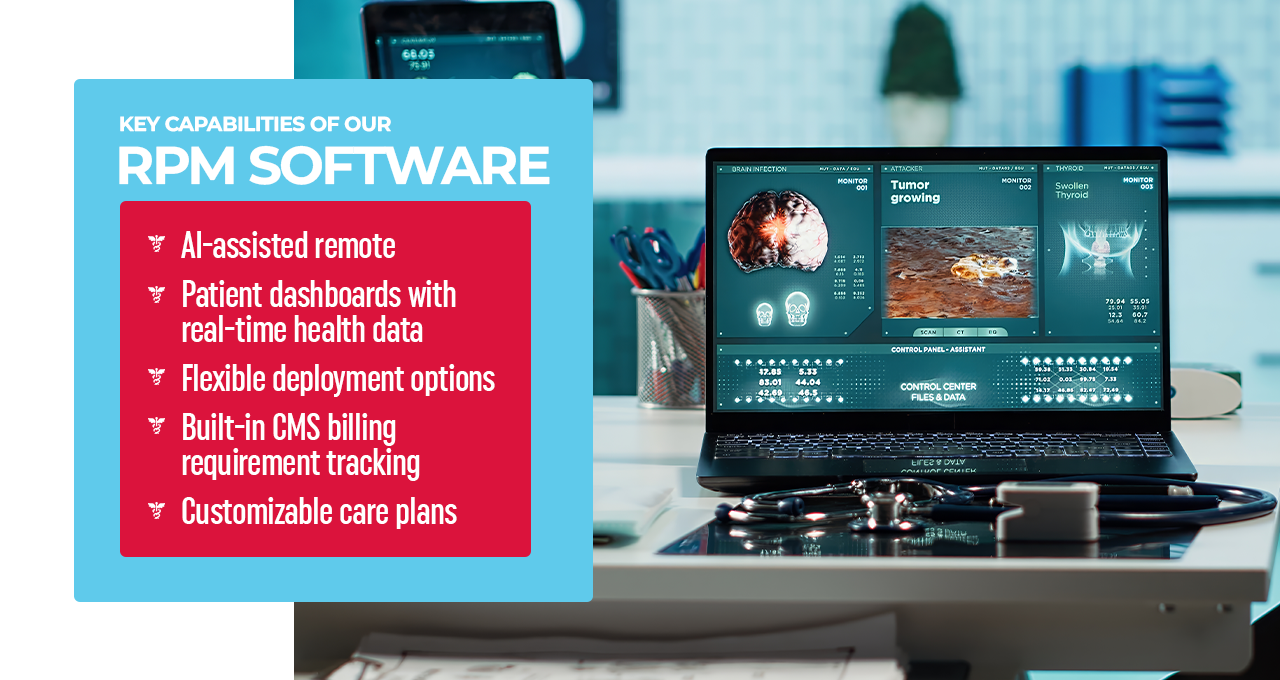
Key capabilities of our RPM software include:
- AI-assisted remote patient monitoring workflows
- Patient dashboards with real-time health data visualization
- Support for Bluetooth, cellular, wearable, Apple Health, and Google Fit-compatible devices
- Flexible deployment options for home care and nursing facilities
- Built-in CMS billing requirement tracking
- Customizable care plans for chronic disease management and recovery
- Secure messaging, symptom tracking, reminders, and patient education
- White-label remote patient monitoring solutions for organizations building branded virtual care programs
Our RPM app also helps providers monitor device reading thresholds, interaction time, and documentation, making it easier to meet CMS reimbursement requirements while reducing manual tracking.
Selecting the Best Fit for Your Practice
The best software is the one that fits your workflow, patient population, and long-term goals.
Before making a decision, ask whether the platform can:
- Scale as your RPM program grows
- Integrate with your current systems
- Improve staff efficiency
- Enhance patient engagement
- Support reimbursement and compliance requirements
DocToDoor's RPM technology balances clinical functionality with operational efficiency, helping healthcare organizations deliver greater long-term value than platforms focused solely on device connectivity.
Wrapping Up
The market for remote patient monitoring software companies continues to grow in 2026, giving healthcare providers more choices than ever. Rather than focusing only on pricing, evaluate platforms based on usability, compliance, integration, and long-term scalability.
If you're looking for a solution that combines AI-powered monitoring, flexible deployment, and CMS-focused workflow automation, DocToDoor offers a practical platform built for today's evolving healthcare environment. Contact our team to book a demo and see how our platform can support your remote care program.