2026 Remote Patient Monitoring CPT Codes
Comparing New vs Ongoing Codes and Why CMS Updated the Framework
Remote Patient Monitoring (RPM) reimbursement continues to evolve along with changes in healthcare workflows. The January 2026 code updates reflect how CPT (Current Procedural Terminology) codes are being refined to align with current clinical practices. In 2026, the Centers for Medicare & Medicaid Services (CMS) introduced two new CPT codes to address structural limitations in the previously established and ongoing codes.
With these additions, clinicians can now better align time and data thresholds and generate more accurate bills for shorter remote patient monitoring periods or specific months of clinical engagement.
If you are part of the healthcare industry as an administrator, revenue cycle leader, or compliance professional, it is essential to have a clear understanding of these new codes. Knowing how they differ from the existing code structure is important for accurate claim submission and audit readiness.
Introducing the New RPM Codes: What Are the Reasons Behind Them?
Until 2025, remote patient monitoring billing relied on fixed minimum thresholds set by the American Medical Association (AMA), which include:
- At least 16 days of device data to bill device supply (99454)
- At least 20 minutes of clinical management time to bill treatment management (99457)
Due to these limitations, clinicians often fail to reimburse when:
- Monitoring lasted fewer than 16 days
- Monthly care management time reached 10–19 minutes, but did not cross 20
- Transitional or episodic programs did not meet full thresholds
The new codes introduced by CMS and effective from January 1, 2026, are developed to align reimbursement with the actual clinical workflows without thresholds that limit billing for short-term monitoring. The purpose of upgrading the CPT codes is to reduce underbilling and maintain transparent documentation standards and compliance guardrails.
An Overview of the New RPM Codes
99445 – Device Supply (2–15 Days)
This code lets clinicians bill when device data or alerts are recorded on 2 to 15 distinct days within a 30-day period.
Requirements
- Must document at least two unique days of data transmission
- Billed once per 30-day device period
- Cannot be billed with 99454 during the same 30-day window
This code supports short-term monitoring such as post-procedure follow-up, medication titration, or transitional care programs.
99470 – RPM Treatment Management (10–19 Minutes)
This code applies when the total RPM clinical time in a calendar month reaches 10–19 minutes.
Requirements
- At least one real-time interactive communication (phone or video)
- Billed once per calendar month
- Cannot be billed with 99457 in the same month
This code covers the reimbursement gap for partial management months.
Foundational RPM Codes (Ongoing Structure)
The existing codes stay in place for full-threshold monitoring.
99453 – Initial Setup and Education
One-time billing per patient for device setup and patient training.
99454 – Device Supply (16–30 Days)
Requires data transmission on 16 or more days in a 30-day period. Mutually exclusive with 99445.
99457 – First 20 Minutes of Management
Covers the first 20 minutes of monthly RPM treatment management and requires live interactive communication.
99458 – Each Additional 20 Minutes
Add-on to 99457 for every additional 20-minute increment.
Core Differences of the New Codes and Ongoing Codes
1. Flexibility on Data Threshold
Old Model: Minimum 16 days of monitoring needed
New Code Structure: 2–15 days billable under 99445
With the new codes, healthcare staff can offer episodic and short-term monitoring and avoid revenue loss in such scenarios.
2. Adjustment for Time Threshold
Old Model: Minimum 20 minutes needed
New Code Structure: 10–19 minutes billable under 99470
This gives priority to meaningful clinical oversight even when it does not meet or extend the 20-minute thresholds.
3. Exclusivity Rules
- 99445 and 99454 cannot be billed together in the same 30-day device period
- 99470 and 99457 cannot be billed in the same calendar month
Providers need to develop claim logic to implement these exclusivity rules.
Operational Implications for Healthcare Organizations
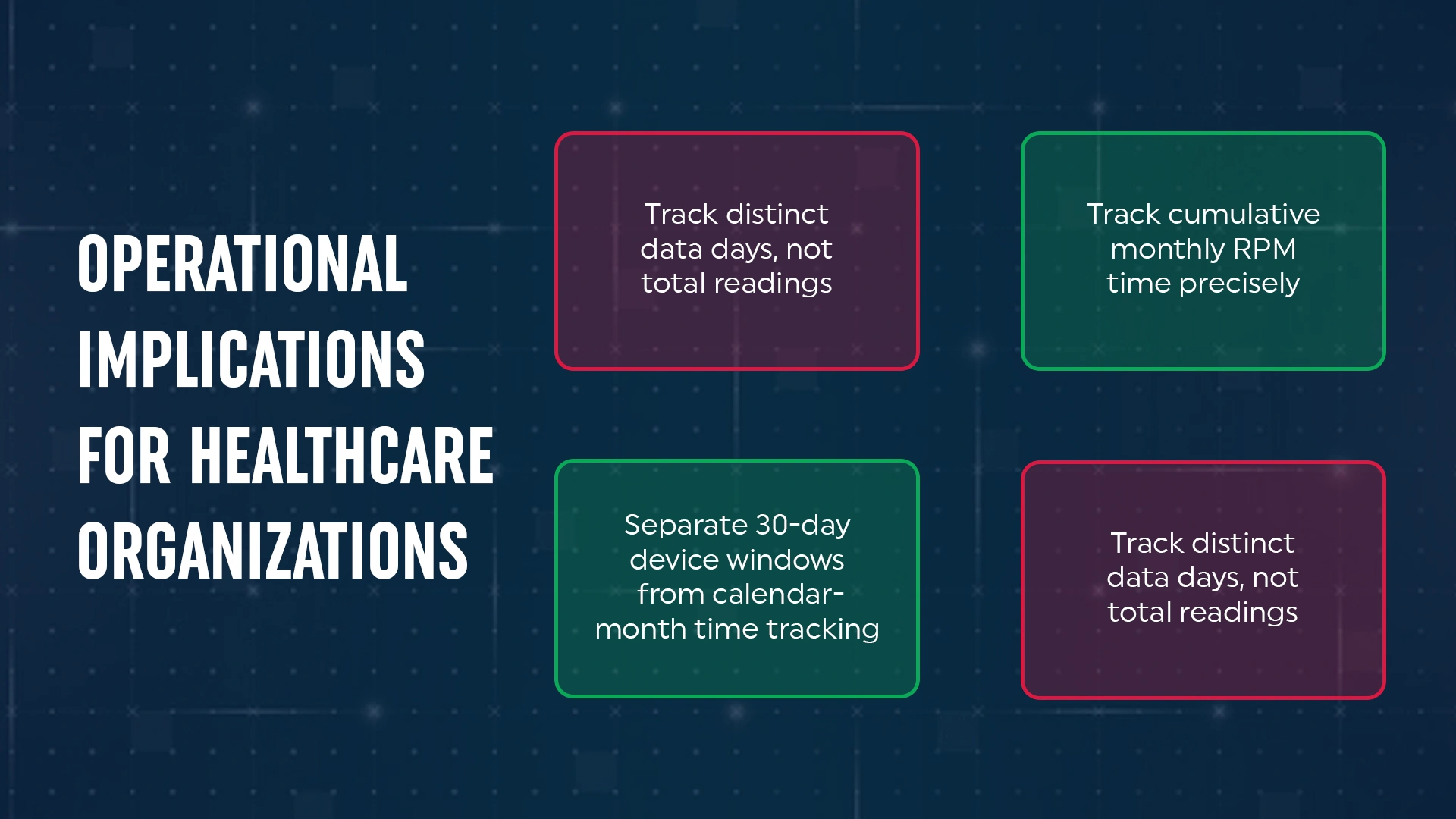
In order to remain compliant and optimize reimbursement, you need to:
- Track distinct data days, not total readings
- Track cumulative monthly RPM time precisely
- Separate 30-day device windows from calendar-month time tracking
- Store documentation of interactive communication, including timestamps and modality
Organizations using structured remote patient monitoring devices, such as those offered by DocToDoor, must ensure system logic aligns with these thresholds before submitting claims.
How an RPM Platform Supports Compliance and Billing Accuracy
Due to the CPT code upgrade, RPM billing is becoming more thorough. Also, to maintain compliance, RPM technology is advancing. RPM platforms like DocToDoor automate the tracking of distinct data days, total monthly monitoring time, and rules for code use.
With built-in guardrails, our RPM system prevents incorrect code combinations and alerts clinicians if proper thresholds are not met before claim submission. Fully integrated with PointClickCare EHR, our AI-driven RPM system reduces billing errors and improves claim accuracy.